

Assurance of Learning (AoL)
AoL is based on monitoring how well students learn what is expected of them in Hanken’s various degree programmes. In the AoL processes, goals for student learning are defined and monitored to develop the programmes and improve student learning. Hanken’s AoL processes cover Hanken’s Bachelor’s programmes, Master’s programmes, Executive MBA programme, and Doctoral programme.
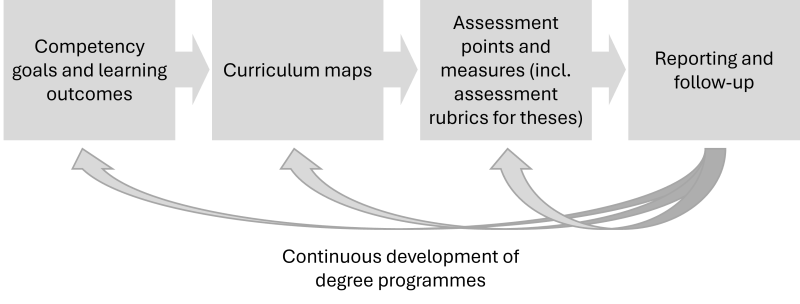
An overview of Hanken’s AoL processes is shown in the figure below. The different stages of the process are described in more detail in the various sections on this page.
- The AoL process is grounded in the school’s mission and strategy (see: Strategy: Hanken 2030). From these, competency goals and learning outcomes are defined for each degree programme.
- Degree programmes are planned so that the competency goals and learning outcomes are sufficiently addressed; curriculum maps are used as a tool for this in curriculum planning.
- Student learning in relation to the learning outcomes is monitored through regular assessment. A number of assessment points and measures are used to measure the learning outcomes. Assessment rubrics for Bachelor’s and Master’s theses play a significant role in AoL assessment, as they are used both for thesis assessment and for collecting AoL data.
- The collected data is compiled annually for reporting to internal bodies and stakeholders who identify development needs and plan and implement changes to the degree programmes. These are then monitored in the next round of assessment, so that the programmes are in continuous development.
Hanken’s guidelines for AoL are summarised in the Hanken Assurance of Learning policy (approved by the Academic Council 5.3.2026). The AoL policy can be found on Hanken's web under Rules and Regulations (section: Guidelines for teaching and supervision). All the information about Hanken’s AoL-processes can be found on this webpage.
Hanken’s AoL policy and processes follow international guidelines and standards.
Competency goals and learning outcomes
The AoL process is built on the competency goals and learning outcomes that have been established for all of the degree programmes at Hanken. The competency goals define the broad competencies that Hanken expects all students to attain during their studies, irrespective of degree programme. Programme specific learning outcomes specify what the competency goals entail for each programme. The learning outcomes define the specific knowledge and skills that students are expected to have once they graduate from a degree programme. The learning outcomes show the expected development in competencies as students progress between degree levels (from Bachelor’s to Master’s to Doctoral).
The degree programmes at Hanken share four key competency goals, which define competencies that are key for students at Hanken to learn irrespective of degree programme:
- Knowledge in economic sciences
- Analytical and critical thinking skills
- International competencies
- Sustainability competencies
For an overview of the learning outcomes for all Hanken’s degree programmes, see the following documents:
| In Swedish | In English |
|---|---|
Curriculum maps
The AoL competency goals and learning outcomes should be considered in the curriculum planning to ensure that all Hanken students attain these central competencies, at the level specified in the learning outcomes. Degree programmes should be planned so that the established learning outcomes for a programme can be attained. The focus is on the programme as a whole; learning outcomes are addressed to varying extents in different majors and courses.
Curriculum maps are used to ensure that competency goals and learning outcomes are addressed to a sufficient extent within a programme. A curriculum map provides an overview of the courses in a programme in which the programme’s learning outcomes are covered. Curriculum maps are created during the curriculum planning every second year (see: Teachers’ responsibilities, section: Curriculum planning).
Curriculum maps are maintained for Hanken’s Bachelor’s and Master’s programmes. Templates are used as the basis for the maps; see:
Assessment points and measures
The learning outcomes for the different degree programmes are monitored through a number of measures, through which data are collected on how well students attain the established goals. Assessment is conducted at various assessment points, primarily theses as well as different surveys. The measures consist mainly of direct measures, but also indirect measures.
The table below summarises the assessment points used for AoL in Hanken’s various degree programmes. An overview of all measures used can be found in Hanken’s AoL reporting (see section: “Reporting and follow up”).
| Programme | Assessment points |
|---|---|
| Bachelor’s programmes | Bachelor’s thesis The Finnish Bachelor’s Graduate Survey |
| Master’s programmes | Master’s thesis The Finnish Master’s Graduate Survey |
| EMBA-programme | EMBA development project (thesis) Hanken Executive MBA Alumni Survey for Graduates |
| Doctoral programme | Proposal to the Doctoral Studies Council concerning approval of doctoral thesis and AOL |
Assessment rubrics
The most significant assessment points used in Hanken’s AoL processes are the assessment rubrics for Bachelor’s and Master’s theses and the EMBA development project (thesis). These are used both for the evaluation of theses and for measuring several of the learning outcomes in the Bachelor’s, Master’s, and EMBA programmes. The same rubrics are used across all programmes/majors at the same degree level.
See the following documents for the assessment rubrics:
| In Swedish | In English |
|---|---|
| Bachelor’s programmes | |
| Master’s programmes | |
| EMBA-programme | |
| - | |
|
Doctoral programme |
|
For supervisors
Supervisors must fill in theses assessments in the corresponding Webropol-forms. For more information and links to the forms, see: Assessment of theses.
Reporting and follow‑up
The learning outcomes of the programmes are closely monitored, and both programmes and processes are continuously developed to support student learning. At the end of each academic year, AoL reports are compiled and reviewed by various bodies at Hanken (see section: “Division of responsibilities”).
AoL reporting is done at the programme level; it is not individual students who are assessed, but rather the content and structure of the degree programmes.
Development over time is followed up in an AoL assessment plan, which tracks how well the learning outcomes in the different programmes have been attained and documents plans for development.
Hanken’s AoL reporting (available to Hanken staff): Hanken Assurance of Learning (AoL) report
Hanken’s AoL assessment plan (available to Hanken staff): Hanken AoL assessment plan 2025-
Division of responsibilities
The division of responsibilities in Hanken’s AoL processes is summarised in the table below.
| Division of responsibilities (RASCI) | Body/unit |
|---|---|
| Responsible | Committee for AoL and Quality (AoLQ Committee) |
| Accountable | Academic Council (AC) Education Council (EC) Department Councils, Doctoral Studies Council (DSC), EMBA Council |
| Supporting | Quality Assurance team, Teaching Lab |
| Consulted | Departments and subjects, programme committees |
| Informed | Rectorate, departments and subjects, programme committees |
The AoL work at Hanken is headed by the Committee for AoL and Quality (AoLQ Committee). The committee’s responsibilities include proposing revisions to Hanken’s AoL processes, monitoring AoL results, and identifying development needs. The committee consists of faculty, staff, and students. The committee is appointed by the Rector and has a term of three years.
Decisions concerning Hanken’s AoL processes are decided on by the Education Council (EC). The Education Council is accountable for Hanken’s AoL processes, approves revisions to AoL processes, and approves changes to degree programmes. Strategic changes are addressed and decided upon by the Academic Council (AC).
Decisions on changes to the curriculum of degree programmes are made based on proposals from the Department Councils. For matters concerning the Doctoral programme, decisions are made based on proposals from the Doctoral Studies Council. For matters concerning the EMBA programme, decisions go through the EMBA Council.
Hanken’s AoL processes are coordinated by the Quality Assurance team in collaboration with Teaching Lab. If you have questions about Hanken’s AoL processes, you can contact aol@hanken.fi.
Departments, subjects, and programme committees are consulted on matters concerning the development of Hanken’s AoL processes and are provided with AoL results relevant to their majors and programmes. All AoL reports are shared with the Rectorate.