

AI reshapes Nordic labour markets – but human expertise remains key
In his speech, Juhana Vartiainen, professor of practice at Hanken School of Economics, outlined how AI may reshape labour markets and challenge Nordic institutions. Vartiainen described AI as comparable to countries starting to trade with a country specialised in automation. This will in principle lead to increases in both productivity and living standards.
“The firms that will succeed best at this will be the ones that are quite bold in reorganising their activities and ruthlessly streamlining their production processes.”
So what will be left for humans? Vartiainen argued that tasks involving human interaction or those that are difficult or expensive to automate will likely remain.
“With increased automation the average income will rise, there will be a higher demand on luxury human-to-human services. This is a positive scenario. Most of us will be able to afford finer things.”
The Nordic model is well equipped for change
According to Vartiainen, Nordic labour markets are combining openness to markets with strong risk-sharing mechanisms such as progressive taxation, social insurance, education and collective agreements.
“The global economy is a huge source of wealth but also a source of instability. When you create social insurance and spread the risks among all the Nordic citizens, this is really the recipe for success, combining the best of capitalism and socialism.”
Vartiainen argues that the Nordic countries should be relatively well equipped to handle the technological changes at hand, since they have always embraced change and shared the risks. He concluded that it is crucial that we maintain trust in our welfare state and institutions, and avoid becoming politically polarised, even if unemployment would rise sharply in certain groups.
AI is reshaping skills and productivity
While Vartiainen’s focus was on the macro level, Sofia Bougt-Hernnäs, assistant professor of economics at Hanken, showed how AI is already reshaping skills and work at the individual level. She noted that automation has led to around 140,000 routine jobs disappearing in Finland between 2000 and 2014. The new thing is that AI breaks the boundaries of what can be automated.
“AI can listen and analyse workers’ behaviour and then statistically model what step should follow to mimic the workers’ behaviour. Anything that workers do become training data that they can work on”.
Bougt-Hernnäs cited evidence from a study showing that introducing AI assistance in a customer service setting increased productivity by up to 20 per cent. The largest gains were, however, seen among the lower skilled workers which suggests that AI may help narrow skill gaps at least in the short run.
“People’s expertise is still needed. It’s needed to verify, it’s needed to be held legally and morally accountable for what AI does”.
Young workers face new challenges
According to Bougt-Hernnäs, as AI is now beginning to automate cognitive tasks particularly at the entry level, this has already harmed employment of young workers in AI-exposed occupations.
“If expertise is still needed, but junior jobs are disappearing – how are people supposed to build this expertise? We need to design AI tools that will improve learning and enhance human thinking.”
Bougt-Hernnäs concluded by stressing the importance of rethinking education and especially on-the-job learning, which might have to be deliberately arranged rather than being a positive side effect at work.
“There might be a need for government support to ensure that the on-the-job learning happens and that the training is profitable both for the individuals and for the firms.”
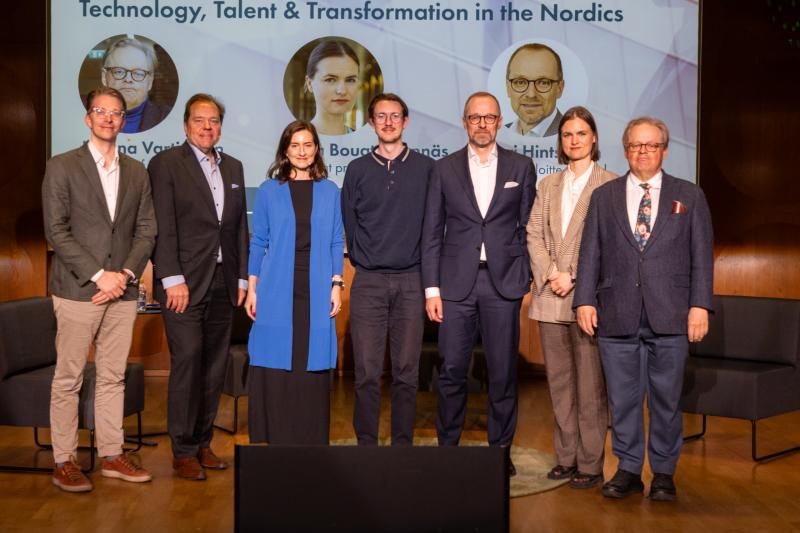
Other speakers at the event included Lari Hintsanen, CEO of Deloitte Finland. Lotta Vuoristo, chief people officer at RELEX Solutions, Mika Gabrielsson, dean of education at Hanken, and Philip McCoy, master’s student at Hanken, participated in a panel discussion on topics such as how to bridge the experience gap and how to ensure AI literacy in the future. The host of the event was Jesper Haga, head of the Department of Finance and Economics.
Text: Marlene Günsberg
Foto: Gustaf Hafström