

Frontiers 2026 — Day 1: Tuesday, June 30
-Overview
-Presentation Information
-Conference Opening
-Plenary: Finding Hope and Sisu in Times of Adversity
-Special Session Details
-Plenary: Rethinking Resilience in a Changing World
-Meet the Editors of Service Journals
-Gala Dinner
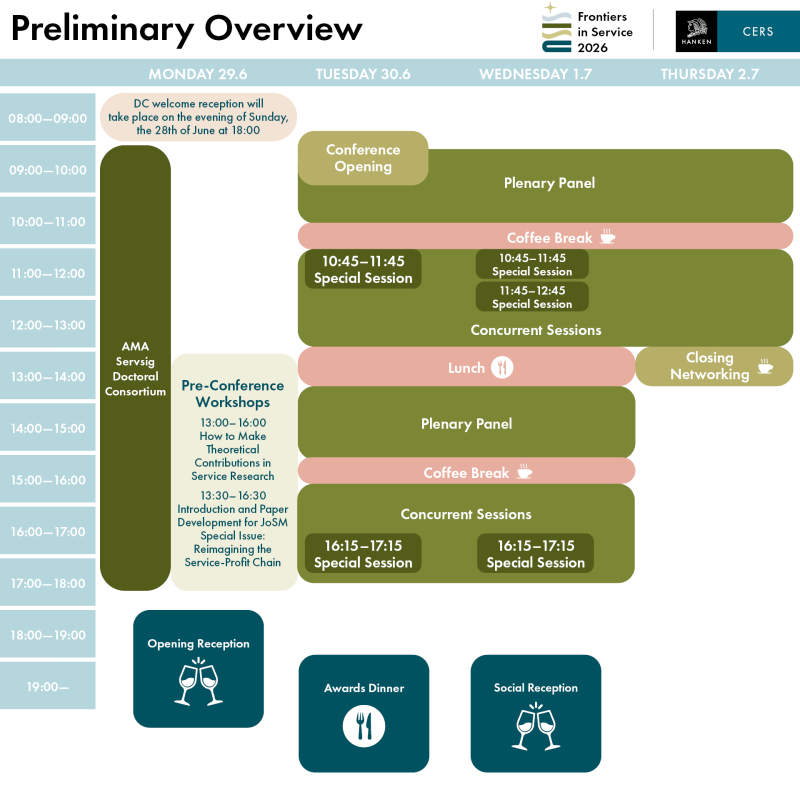
Information about Day 1: Tuesday, June 30 Presentations
For detailed information about the presentations at the 2026 Frontiers in Service Conference, please refer to the file below.
Conference Opening | 09:00, Assembly Hall
Welcome by Conference Chair Kristina Heinonen (Professor, CERS - Hanken School of Economics) and Co-chairs Johanna Gummerus (Professor, Hanken School of Economics and Director of CERS) and Robert Ciuchita (Associate Professor, CERS - Hanken School of Economics).
Opening Remarks by Ingmar Björkman (Rector of Hanken School of Economics)
Plenary Session: Finding Hope and Sisu in Times of Adversity | 09:15, Assembly Hall
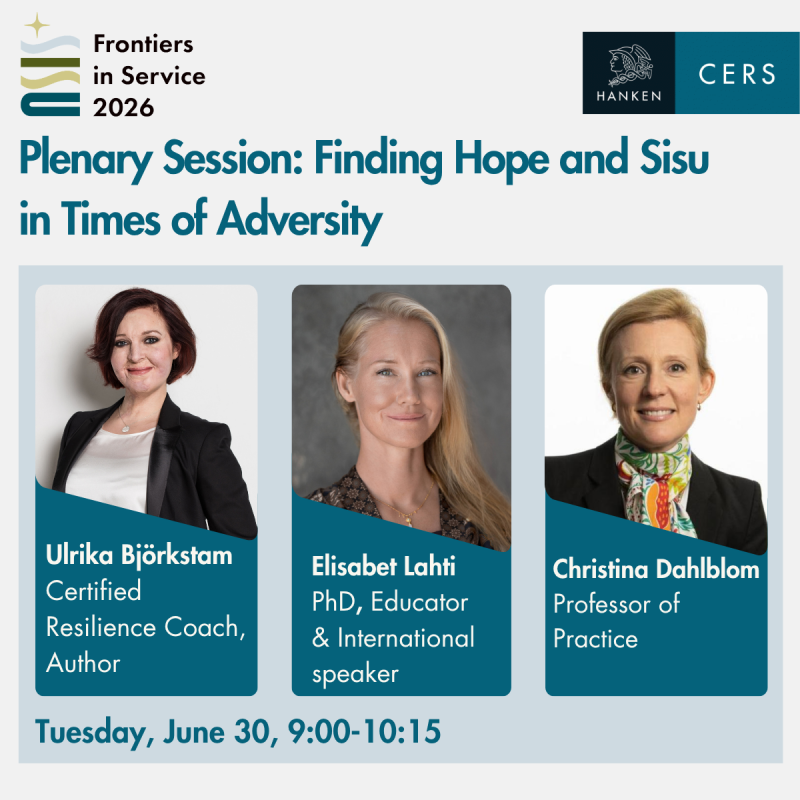
In our opening plenary, Finding Hope and Sisu in Times of Adversity, we invite you to two inspiring keynotes on Sisu, that is an age-old Finnish word derived from sisus, meaning the inner core. Ulrika brings to life the message that sisu and resilience are not only about enduring hardship but also about cultivating hope, meaning, and growth along the way. Ulrika’s talk is a moving story about how each of us can uncover hidden resources, embrace vulnerability, and transform setbacks into stepping stones. Elisabet in turn frames sisu as a form of somatic intelligence for acting under uncertainty and pressure. Drawing on embodied cognitive science and applied research, the talk explores how sisu, practiced through self-leadership and inner awareness, fosters resilience and collective uplift, positioning service as human-centered value creation.
Ulrika Björkstam, certified resilience coach, author, and keynote speaker, brings to life the message that sisu and resilience are not only about enduring hardship, but also about cultivating hope, meaning, and growth along the way. Her talk is a moving account of how we can uncover hidden resources, embrace vulnerability, and turn setbacks into stepping stones.
Elisabet Lahti, PhD, educator, researcher, and international speaker, explores sisu as a form of somatic intelligence for acting under uncertainty and pressure. Drawing on cognitive science and applied research, she shows how sisu, practiced through self-leadership and inner awareness, can strengthen resilience and contribute to collective uplift.
The session is moderated by Professor of Practice Christina Dahlblom, who brings extensive experience from both the corporate and academic worlds. She has held leadership roles as a manager, CEO, partner, and entrepreneur, and currently serves as Associate Dean of Executive Education and Corporate Relations at Hanken School of Economics. Drawing on her experience at the intersection of academia, business, and society, she will guide the conversation.
Special Sessions | Tuesday, June 30
The Core of Service. The Missing Link Between the Beginning and End
Customers create value through their use of goods and services. However, what drives them to choose a particular offering in the expectation of receiving desired value? This session explores this missing link.
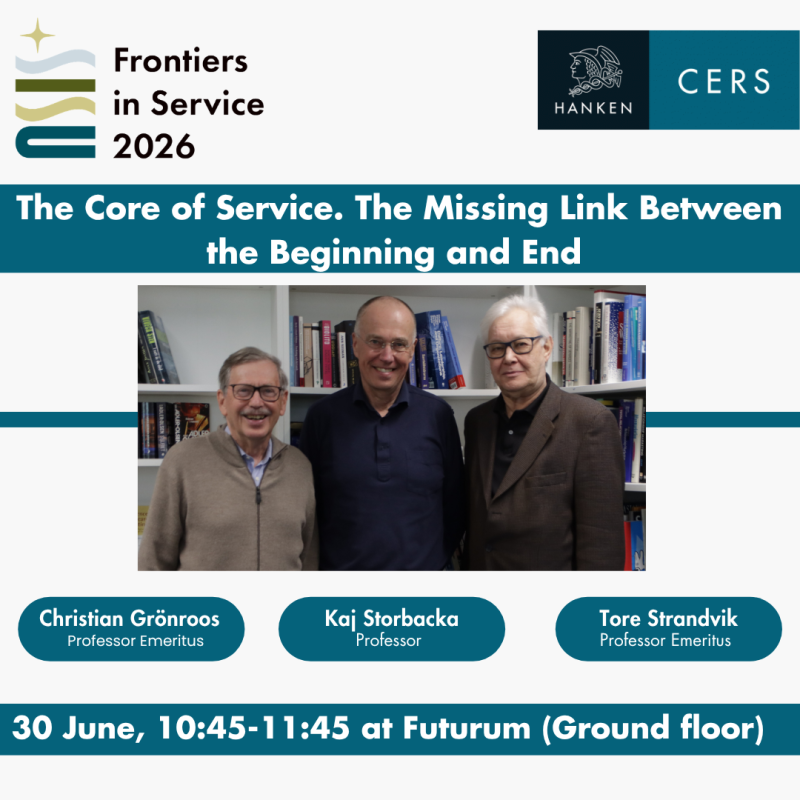
Organizers: Christian Grönroos, Tore Strandvik & Kaj Storbacka (CERS – Hanken School of Economics)
Commentators: Janet McColl-Kennedy (The University of Queensland) & Ray Fisk (ServCollab)
Moderator: Lia Patricio (INESC TEC, University of Porto)
*Please note that this session lasts 60 minutes.
Lunch I 12:45
Ground-floor restaurant and Auditorium Maxen on the second floor
Plenary: Rethinking Resilience in a Changing World | 14:00
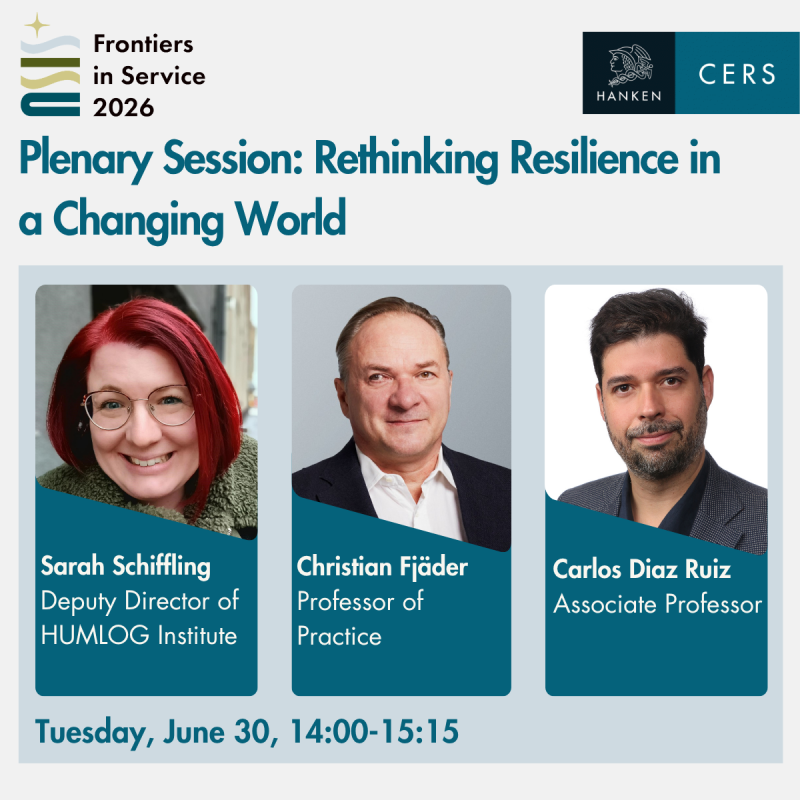
This session explores resilience as the capacity to face disruptions such as the series of crises we have faced over the past ten years. Bringing together perspectives on national, global, and data resilience, the discussion will examine how we can build more resilient futures in an increasingly volatile world.
Sarah Schiffling is the deputy director of the HUMLOG Institute at Hanken School of Economics. She is working on research projects such as the Horizon Europe funded ReMuNet on resilient transport networks and Business Finland funded MedView on medical waste management in Vietnam.
Christian Fjäder is a distinguished expert in geostrategy, national security, and societal resilience, currently serving as the Head of Research at the Economic Security Forum (ESF) and Professor of Practice at the Hanken School of Economics. With a career spanning over two decades across the public, private, and academic sectors, he has experiences as a Senior Research Fellow at the Finnish Institute of International Affairs (FIIA), the CEO of Geostrategic Intelligence Group (Geostrat) Ltd., as well as from leadership roles at Nokia and Nokia Siemens Networks.
Carlos Diaz Ruiz is an Associate Professor at Hanken School of Economics in Finland. He is the author of Market-Oriented Disinformation Research: Digital Advertising, Disinformation and Fake News on Social Media and has published in leading journals including Journal of Public Policy & Marketing, the Journal of Marketing Management, and New Media & Society
Meet the Editors of Service Journals | 16:15, Futurum
Panelists: Florian Von Wangenheim (Editor-in-Chief, Journal of Service Research), Marianna Sigala (Co-Editor, Journal of Service Theory and Practice), Mark Rosenbaum (Co-Editor, Journal of Services Marketing), Sertan Kabadayi (Co-Editor, Journal of Service Management); Moderator: Robert Ciuchita (CERS – Hanken School of Economics)
*Please note that this session lasts 60 minutes.
Gala Dinner | 19:00

The Gala Dinner on Tuesday, June 30 will be held in the Juhlasali at Ravintola Töölö.
Address: Runeberginkatu 14–16
Ravintola Töölö is located in a building designed in the 1950s by
architects Woldemar Baeckman and Hugo Harmia, representing
Helsinki’s post-war reconstruction-era architecture. The building
has been carefully restored closer to its original 1950s character,
preserving its traditional and elegant atmosphere while maintaining its
functional role as an event and restaurant venue.
From Hanken’s perspective, the venue is especially significant, as the
former Helsinki School of Economics building reflects its historical
connection to the institution and its long-standing academic legacy.